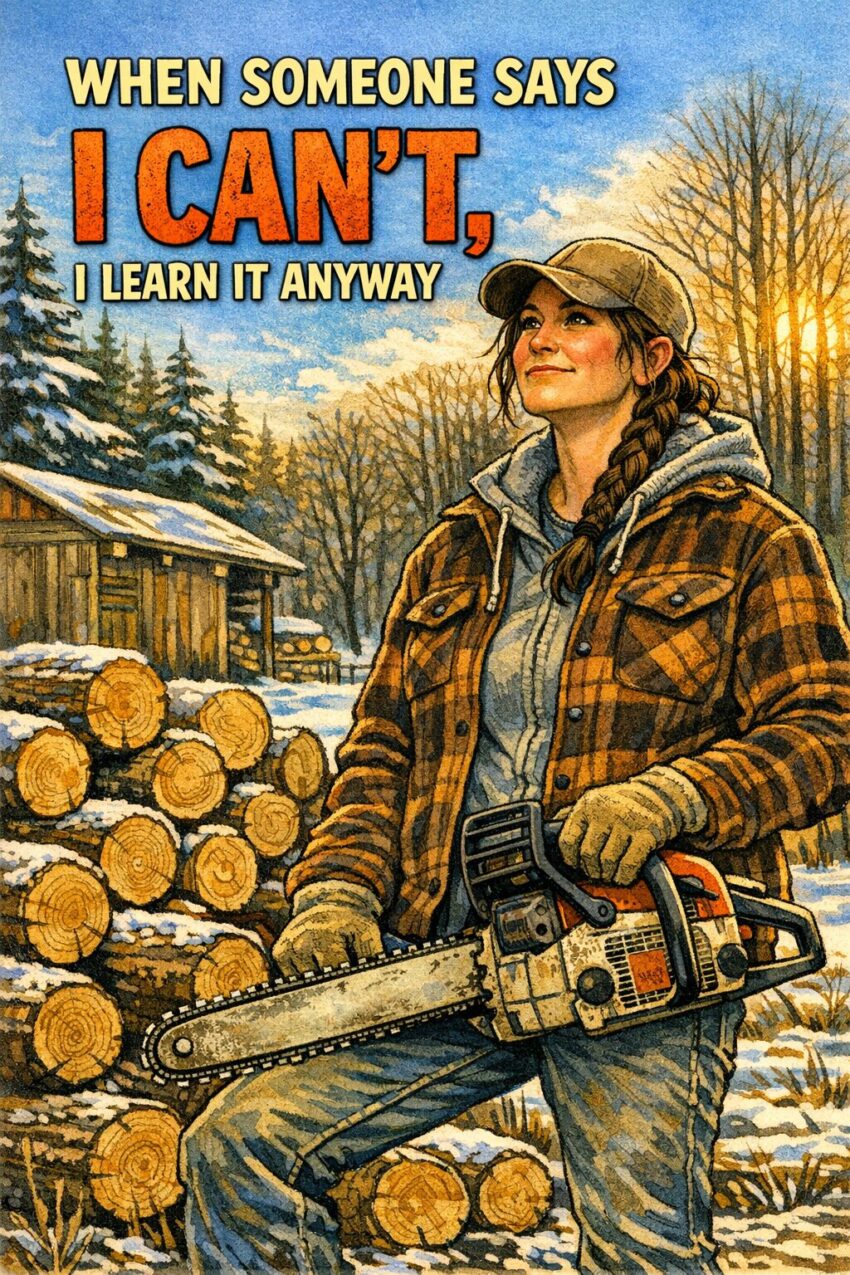
I tend to pride myself on my ability to learn quickly and do things on my own. For example, a couple of weeks ago it was still cold enough that we needed to use the woodstove — but we were out of wood.
Last year, my husband taught me how to use his chainsaw. So I told him I would get some wood ready to be split, and when he came home we could finish the job together.
Sounds simple enough, right?
Because of issues with my shoulder, getting the chainsaw started can be a challenge. I told the kids to wait until I tried starting it before everyone bundled up. Two pulls — and it started. I was so excited and ran inside, told the kids to get ready, and we headed out.
I cut down a few smaller trees, and then mentally smacked myself for not checking the gas and oil first. Sure enough, it ran out, so we headed back to the garage. I refilled everything and pulled the cord again. Nothing. Pulled again. Nothing. After several tries, frustration got the best of me. I had to give up. I just couldn’t get it restarted.
Then I remembered we had left a few logs out back before winter. I grabbed the tractor and a couple of sleds, and the kids and I hauled up the stragglers to be cut and split. With the frustration still lingering, I told the kids we were going back inside and that after lunch I’d try again.
After lunch — SUCCESS! I got it restarted, and we went back to work. I cut down three more small trees and chunked everything up for splitting.
Most women would have waited for their husbands to come home, but I’m a bit different. I’m proud of myself when I can do something I used to have to wait for him to do. Wanting to learn these things isn’t about making my husband feel less needed or less capable. Believe it or not, I’ve actually been told that learning to use tools, the wood splitter, and the chainsaw is “wrong” — that it’s not meant for women. I find that absurd.
Even when I began hunting in 2015, several of my husband’s friends asked if it bothered him. I’m glad his response was simple: two people hunting means twice the meat, and it all goes into the same freezer. Anyone who hunts knows two sets of eyes are better than one.
My reasoning was different, though. We live a very self‑sufficient lifestyle — or, as I prefer to think of it, God‑sufficient, because without Him we have nothing. And I always think about the “what ifs.” What if something happened to my husband and he couldn’t split wood, fell trees, build, or fix things around the homestead?
When we first started, I was clueless about almost everything. I couldn’t even get a plant to grow. Our first two or three years, we bought all our garden plants from the local nursery.
Today, I save several types of seeds, I’m learning to save others, and I start our garden from scratch each spring. But none of this was learned overnight, and it certainly wasn’t perfected overnight. I spent about ten years trying to learn how to make sourdough bread with naturally caught yeast. It wasn’t until last summer that I finally figured it out — and now I have two sourdough starters, Elvira and Atlas, that I rotate for all kinds of baked goods.
Luckily, I’m not someone who gives up easily. I’m determined. And if I’m being 100% honest, the more someone tells me I can’t do something, the harder I try. It used to be about proving them wrong. As I’ve gotten older, it’s become more about proving to myself that I can.
I have several certifications, diplomas, and awards — not because I needed them, but because I love to learn. If I can get certified in something, I probably will, even if I never use it. The knowledge I’ve gained through curiosity has opened doors I never expected.
Even as I type this, I’m working on getting my ham radio license. Why? Simple. One day it may be the only form of communication we have. Some people call that paranoia. I call it being prepared. Maybe I’ll never need it — but if you watch the same news I do, you just never know. Learning keeps me entertained, and honestly, there’s so much out there to learn if you want to. Not many people I know have books on quantum physics — but I do, because I was curious.
In an age where information is literally at your fingertips in lightning speed, how could you not want to take advantage of that? I have so much “useless” knowledge about things that will probably never matter — like the plastic end of a shoelace being called an aglet. I think I learned that from Jeopardy years ago, and for some reason it stuck.
As a homesteader, I’ve learned one of the most important lessons: learning never stops. Even when you think you know something well, there’s always room for improvement or a new trick that makes things easier. This happens to me all the time — and I welcome it. I’ve learned new garden tricks, tips for goats, chickens, rabbits, turkeys, and even pigs. Sometimes those little things have meant the difference between life and death.
I remember dealing with bloat for the first time in our buck. It was terrifying at the thought of losing him. I reached out to a woman whose blog I’d followed for years, not expecting a response. She walked me through everything step by step, emphasizing how fast I needed to act. Within a couple of days, he was back to being healthy and normal. Afterwards, I sent her a picture of him afterward, thanking her over and over.
Truth is, I never expected her to respond. But she did — and I’ve never forgotten her generosity during one of the scariest moments we’d had on the homestead up to that point.
Learning — real learning — is rarely convenient, glamorous, or easy. It’s messy. It’s humbling. It stretches you in ways you didn’t expect. But it also builds a kind of quiet confidence that no one can take from you.
Every new skill I learn makes our homestead stronger, our family more resilient, and my faith deeper. Because every time I push through frustration, fear, or failure, I’m reminded that God equips those who are willing to step forward.
And if there’s one thing I’ve learned above all else, it’s this:
You don’t have to know everything — you just have to be willing to learn.